Showing posts with label Events. Show all posts

Thursday, February 7

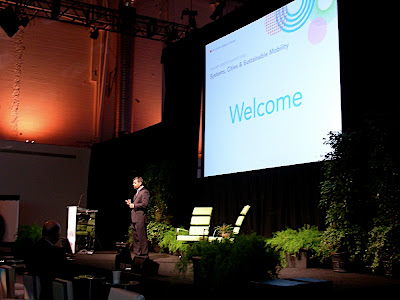
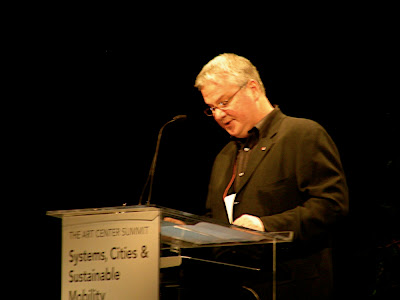
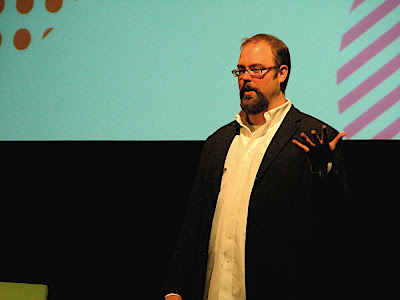
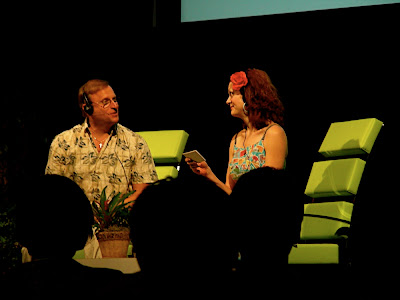
Sustainability Summit Day 2

V. Sumantran started the day off by talking about the issues concerning a low-cost car, with particular attention to its application in India. He noted that there are a number of solutions available, it is the balance of numbers that go into affordability for the population of India. There is also the consideration of an urban car [IE the Smart Car] versus a low cost car [like the Nano]. In the interim the needs will be met by people mobilizing private capital. In the long term, mass mobility will demand newer systems.

Geoff Wardle introduced a twenty minute clip from his hour long interview with Gordon Murray. The full interview is available on the Summit website.


Mark Goodstein moderated a panel of Christer Lindstrom, Dan Sturges and V. Sumantran. They talked about the need for a paradigm shift in terms of technology and its application. There also needs to be intelligent multi-modal mobility options. There is a currently a serious gap in efficiency that needs to be addressed [driving around with 1 of 5 seats filled doesn't cut it]. What to do though? Consider this, the best trip is the one you don't have to make [think Netflix, mentioned earlier in the conference by Alex Steffen]. All this things that are talked about are possible, we simply have to just do it. In World War II the US shifted from manufacturing cars to war goods in a matter of weeks. Will power and determination make anything possible. People need to feel the urgency and need more.


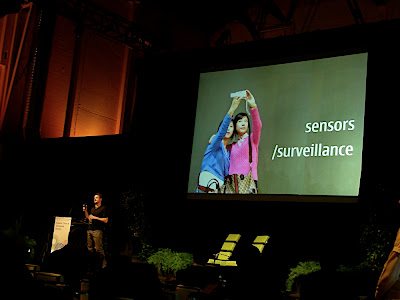
Katherine Bennett introduced Jan Chipchase from Nokia, who gave a wonderful presentation about observation, trends and designing in context. People find solutions for what they need, and he had many citations of this happening around the world [particularly in Asia]. There are also amazing examples of simple solutions, distilling a gas station down to the absolute simplest form, a single brick and bottle of petrol in Thailand. He also gave a wonderful list of upcoming trends, such as status casting using AIM and Twitter, and translated this into the concept of doing the same for products. Consider a service that lows people know exactly when the product they want is in the store, or the exact location a bus, so you know how much time you have the magazine stand.
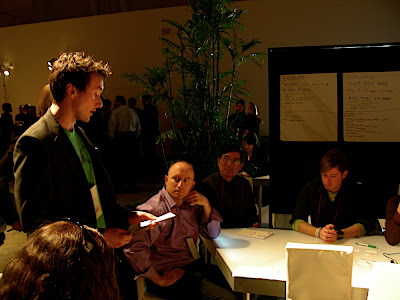

Lloyd Walker talked about the mVIP Future Scenario Application again, and prepared the attendees for a Texas Hold'em Style game situation. This second go at it was easier for people to grasp than the first day. There is a learning curve to these cards, I think people were better abled to deal with them this time around. There were many interesting ideas that came out of it, that the organizers of the Summit are now sifting through. Overall though, I feel it was a success, and heard some inspiring projects with a lot of potential.

Post-Lunch was a fantastic webcast lecture by Hazel Henderson, who did so because she is done with jetting around and flying. I was visualizing again, and the only note I have jotted down is this, she believes we are up to the design challenge ahead of us. I have to say, there was something inspiring and comforting about hearing her speak. She was very impressed by a question from an attendee and offered up her personal contact information to follow up with this person about the specific trials she was facing.
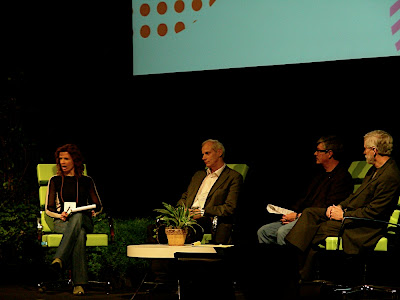

Jayne Poynter moderated a panel with Peter Bishop, Axel Friedrich and Freeman Thomas. It was a passionate panel that talked about how do we change our behaviors towards energy. There was an interesting point about the fact that most of the United States infrastructure for mobility was built in a post-petrol world. In comparison to Europe, where there are many options and structures in place that are easier to adapt to alternate mobility options from pre-industrial days. The physical layout begins to influence our mental construction of the thing, and starts to shape our thoughts.

Geoff Warlde and David Muyres concluded the Summit, by thanking everyone for coming. They also spoke of the immense task ahead for them to synthesize all this information for future reference. They hinted at a timeframe and location for future Sustainability Summits, and openly stated their desire for collaboration on it at all levels, university, corporate and governmental. I believe it was Geoff who called for truth and honesty in design [adding that these two facets are not impediments to industry]. I couldn't agree more.

More to come: the RSVP Dinner from after the Pre-Summit, details from Paul Hawken's Keynote, and photos from the closing Party [which was sadly not on the rooftop as advertised]!!!
Wednesday, February 6

Sustainability Summit Keynote


The keynote on the Hillside campus was not to be missed. Nate Young opened up by talking about Art Center's commitment to Sustainability and again about the visualization of the future student. A designer who interprets the world, develops projects in a relevant context, considers human usability, steps into the gap [and stands for something] and applies the creative process to any application.

There was a highlight reel of the past two days by Art Center Graduate Film Students. Then a special address by John Mizroch, from the US Department of Energy. He spoke of the problem of energy, and the need to diversify in its resources. His final thoughts were on the need to embed sustainability in our lives, don't compromise [especially as designers], think big and reminded us that there is a large opportunity in developing this future.

Stuart Townsend [who just finished he directorial debut on a film about the Seattle Protests] gave an honest introduction to the keynote speaker, Paul Hawken. I need to review the tape I took of Paul's address. There were many good points, the key take away for now, follows. If you look at the data [about the climate, environment, the state of the world, etc] and are still optimistic, look again. It is the people you should look at and be optimistic. We don't need any more heroes, now we just need more human beings. We are doing amazing things that should inspire and motivate. Our imagination is an amazing resource we need to take advantage of.


Summit Day One


The Sustainability Summit is packed full of information, way too much for one day.


Nate Young started the day off, and introduced other speakers throughout the day. Of interest was his talk of the three portfolios student's of the future will need. One of talent [traditional portfolio], one of character [to relate to people and be human] and one of process [thinking, particularly about the topic at hand, sustainability].


Alex Steffen [of World Changing] spoke about the need for a new view of prosperity. The current one of an endless consumption of resources as desirable just isn't working out. Now we are faced with rising developing nations who grew up on Baywatch, and see that as a standard to strive for. We're in no position to preach, and they're in no mood to listen. He did speak positively, leaving us with the advice that we need to tell stories, have compelling examples, be playful, be reminded of who we want to be, and most of all, we need to speak to people's hearts. We can't build what we can't imagine.

Gary Lawrence [of ARUP] talked about Dongtan Eco-City, giving many interesting facts. Of interest and inspiration was his statement that a sustainable life choice is dependent upon nostalgia, fear and aspiration. These concerns have to be considered when taking on a project such as Dongtan. We can achieve sustainability gracefully or through a systems collapse [an idea noted by other speakers throughout the day as well].


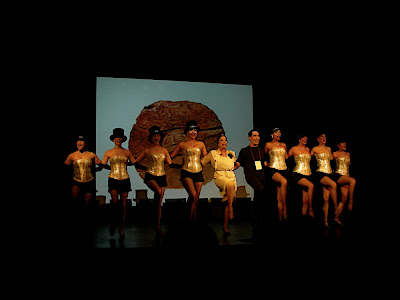
There was a funny future scenario skit, of the 231st Tournament of Roses, with old car parts as petals, and envisioned a future where football teams were renamed because wildcats are a distant memory and some catastrophic imagined event that forced UCLA and USC to combine and form the Brujans.

Henrik Fisker talked about the Designer's Challenge. I was doing some drawings for a presentation during the keynote, so I didn't catch all the details of this lecture. Fisker mainly talked about seeing the need to design a super efficient muscle car, and changing his original business idea to fit this. Biggest take away, Designers need to create the desire for these more efficient vehicles and alternate lifestyles that sustainable mobility requires. It shouldn't just be legislation doing so, and this is a great business opportunity. 

Lloyd Walker talked about Mobility VIP [vision integration project] as an introduction to the break-out session that followed. It's part of system he and others at Art Center are trying develop along with the Sustainability Summit to accelerate the dialogue of future mobility. He spoke of Futurama [referencing Alex Steffen's old vision of prosperity], and the need for disruptive change as an emerging opportunity.


The break out sessions that followed were interesting. Attendees formed smaller groups which were dealt a set of cards that defined a future they needed to design for [in only 15 minutes!]. It was difficult to say the least. The challenges on the cards were vast [and sometimes unrelated]. That is part of the lesson of the exercise though, we cannot always solve every problem with the tools we have. We have to be selective, prioritize and focus our attention to what we can do, with the time that we have. It is also about the creative possibilities of working inside parameters, they confine us as well as guide us.


Post-Lunch, Martin Tillman talked about visualizing future cities, speaking to the importance of services that encourage and embrace positive social actions. This is best illustrated by a number of websites he worked on, a few are Journey On, Walk Score, and Walk 2 Go. He also emphasized the need to visualize these alternatives to people and developers so that they can see the possibilities and alternatives out there.

Gordon Feller moderated a panel with Scott Bernstein, William Browning and Martin Wachs. At this point I was very caught up in visualizing from the break-out sessions, and cannot adequately summarize the conversation that went on.


There were then Five-Minute Pitch Sessions of sustainable mobility ideas from the feasible to strategic. A lot of bicycle sharing going on here. Raul-David V. Poblano talked about Robo-Scooter [click on mobility, then scooter]. Lindsay Smith talked about Rubber Sidewalks. Nathan Mills talked about Johnson Control projects at Art Center. Peter Treadway gave us a wheeled foot update [along with some fantastic footage of various prototypes]. Finally, Andrea White talked about Bikestation.

Hannah Jones, of Nike Corporate Responsibility talked about Sustainability driving the new economy. She likened the challenge of sustainability to JFKs 1961 address and declaration that the US should put a man on the moon before the decade was out [and we did]. Hannah talked of the need for collaboration, sharing and open source in the design field, and cited Nike's precedence in just that.

There were closing remarks by David Muyres and Andy Ogden.

Tuesday, February 5

Pre-Summit Post-Lunch

Lunch was cookies, salad and a mozzarella, tomato and eggplant sandwich.


After that, David Hammond talked about biomimicry, systems and "Swarm Intelligence." He gave some examples of the three basic kinds of biomimicry; form by means of an innovative propeller, process by means of mimicking glue from oysters, and systems by means of waste water treatment. He showed us an amazing video of birds swarming in the air, and talked about how this has applications to traffic control. Humans are apparently have less than average swarm intelligence [while ants have great swarm intellingence].


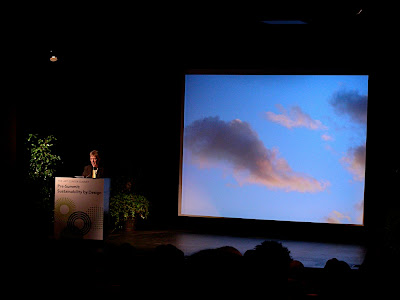
Geoff Wardle gave an inspiring speech, with slides only of blue skys. He couldn't show any slides of what sustainable mobility looks like, because nobody knows yet. Ideas touched upon the idea that the entire idea of sustainable mobility is like an increasingly complex onion, each peeled back layer revealing more complexity. Overall, we need to look beyond just Design Think, and start considering Systems Thinking. He offered to email a copy of his speech to anyone who is interested, I will post at soon as I get it.


Claude Willey [a guy who bikes to work 2.5 hours, one way, 3 times a week from Pasadena to Northridge] spoke about the problems of mobility. He provided background into the history of where these problems stem from. He spoke about the Urban Renewal Program and Robert Moses. Claude strongly stated that mobility is defined by race, class, and access. Another citation to give background to this statement was the story of Cynthia Wiggins. This relates to the idea of Spatial Justice. In closing, the overall theme of this lecture was habitat and mobility for everyone, equally [even wildlife].


Jane Pointer, a former participant of Biosphere 2, talked to the audience about the new economy, and in detail, that of carbon sequestration, taxation, cap'n'trade and the confusing 'additionality' [which she'll explain in person if you didn't understand, which I didn't comprehend enough to pass along to you the reader]. This lecture was an overview of many of the current talk about how to deal with carbon.


John Paul Kusz spoke about counting the truth and the consequences. This amounts to the unintended and unconsidered consequences of our actions. He said to google the Jules Verne Effect, so I did [that result was on the 7th page, I think it's what John was talking about though]. John gave a wonderful list of policy making organizations from around the world [linked here when information is received]. He concluded that we need to Lead Change, citing Patagonia as a prime example. His final remark was gold though, "start a small green business, run it for 5 years, then sell it to a larger company that wants to green itself for millions."


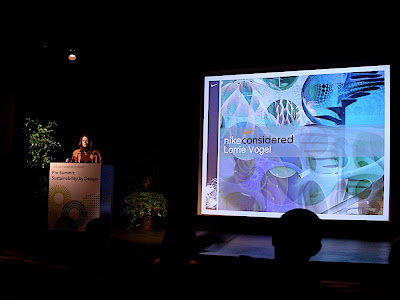
Lorrie Vogel was the final speaker of the day. She is the head designer in charge of Nike's Considered Program. Lorrie explained that Considered is not a single product line, but an ethos at Nike. The ultimate goal of Considered to inform people of the impact of their choices [designers and consumers alike]. And that Considered works not by designing a single line of shoes, but by providing the framework for Nike to reduce its footprint throughout all its products. This includes waste reduction, environmentally preferred materials, solvent reduction and being a change agent [inspiring by example]. Being Green isn't about being granola, its about changing your process.


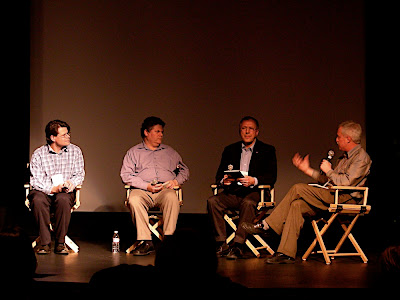
There was a panel discussion at the end of all this, with Joel Makower moderating between Stuart Cowan, Gordon Feller, and Stewart Reed. The biggest take away from this panel was the need for visibility in business and design. People need to see how to change, and we need to reward innovators. There needs to be an execution of policy, and attention to what is necessary for specific regions.


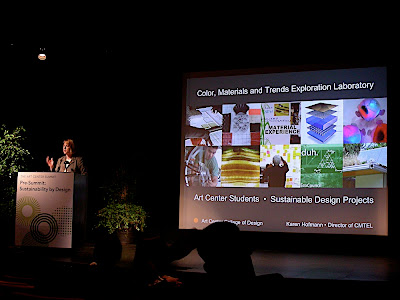
Karen Hofmann closed out the Pre-Summit by talking about the CMTEL lab and the various projects it has going on. This includes a sister CMTEL Lab opening in Tama University, designs storms, and sponsored projects that take advantage of access to the wide selection of materials available. 

I'm reminded of something Tinker Hatfield told me, "a person needs to work on how they can effect their sphere of influence." As a student, this might mean recycling, carpooling to school and signing a petition to have bioplastics in place of styrofoam in your cafeteria. As a professional this might be implementing natural air conditioning for a building. Finally as a political leader, this might mean changing the way a city is planned, or endorsing policy's towards a greener one. 

[In two weeks, the powerpoints from these presenters will be available, except for Geoff Wardle's which is already available, Sunday to Saturday, sunrise to sunset, weather permitting, consult your local almanac for specific times]

Pre-Summit Pre-Lunch


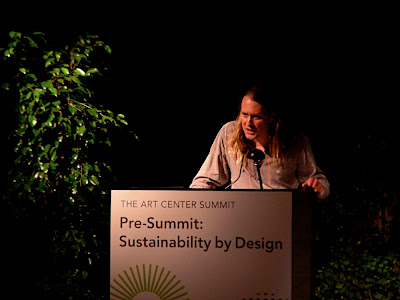
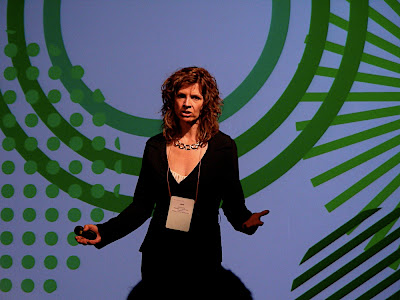
Opened with an intro from Dave Muyers. Then Heidrun talked about sustainability and gave an overall introduction to the speakers of the day.  There has been a lot of talk in the past year, and while this has been good, it has resulted in a lot of noise. The speakers today are meant provide relevant information from credible sources.


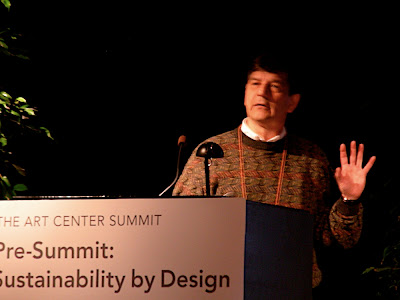
Joel Makower talked about business and sustainability, comparing it to teenage sex. Everyone says they're doing it, and only a few are.  He ended by saying that there is a dysfunctional conversation going on out there. Environment has a different meaning to different people and we have to work on defining meanings.


Stuart Cowan talked about systems large and small. It provided an interesting perspective on how to view sustainability. There was something intangible and inspiring about how he spoke though. I will sum it up by his comment that "the biosphere is a thin shell upon this iron ball" we call earth.


Rob Thompson spoke about the economics of energy. The most poignant part of his lecture was the invisible effects our actions have, such as energy efficient cars leading to more energy consumption.


Scott Bernstein talked about the pursuit of sustainable cities. He provided an interesting anecdote to the humble start of Lloyds of London, and inverse relationship of buying cars and personal savings. The end of his lecture had great information on the concept of Local Efficiency.

Erin McConahey talked about the mini, micro and macro. She used a case study from a past project, a San Francisco Federal Building. She also showed work from a current project, Dontang Eco-City.

Sunday, February 3

TRUNKsale


Was a blast. Thank you to those who could attend. There was buying, selling, singing, signing and at the end of it all, donating. The sun was out, and it didn't rain! I'm going to gage people's reactions to it over the next few weeks, and might try and do another TRUNKsale towards the end of the term. There seemed to be a number of people who would've liked to attended, and were unable to for one reason or another.

More photos of TRUNKsale.